Book Review: how to Fail at Almost Everything and Still Win Big: Kind of the Story of My Life
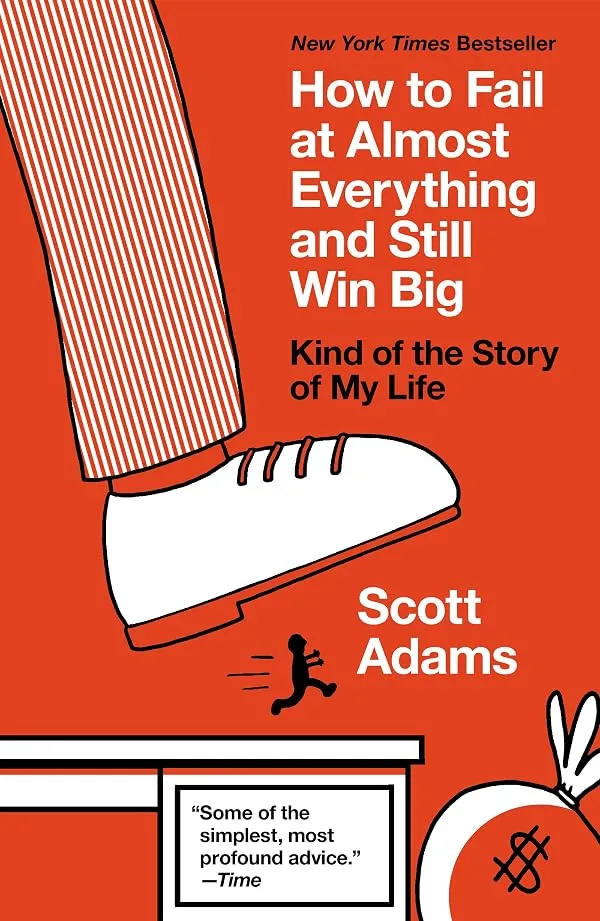
I categorize this as a self help book but it’s quite different from the others I have read. I also consider it simpler and easier to follow advice. I still feel it’s too long for what it’s trying to cover. Or maybe it’s covering too many topics. It’s also a small autobiography. I hoped more of it would his life story.
Usually self help books tell you a simple rule like “Always be improving” (whatever that means) then proceed to give few inspiring stories about how this rule changed lives of X,Y,Z and chapter is done.
This was more like a conversation and author’s experiences about the topics. And as he says in the book he tries to be a friend discussing these topics with you. There are a lot of advice in the book ranging from business to health and curing incurable diseases. But with all of that I quite liked the book. I put it beside something like Atomic Habits. So let me tell you what is contained in the book.
The book talks about success and in the context of the book success means to succeed in making something that people want and keep doing it and make money. Adams success is the Dilbert comic. But he tried various side businesses on the side. Dilbert is accurate in its jokes. I think that makes it funny. I suspect KRAZAM and Kai Lentit were also programmers seeing the dysfunctional parts of software companies and that’s why they can make good jokes. And from this he draws the conclusion that a lot of various skills and trying different things gives you knowledge to be able to succeed.
“I have a long history of profiting from failure. My cartooning career, for example, is a direct result of failing to succeed in the corporate environment”
He’s conclusion is that if you learn multiple skills and mix them it’s going to give a higher chance of success. “Good + Good > Excellent”
“is beneficial, you wouldn’t feel particularly motivated. When you accept without necessarily believing that each new skill doubles your odds of success”
So he suggests to learn various topics but there’s no specifics to learn. I think that’s for each person to figure out what you like learn and use various skills that you have. This reminded me of What to learn from Dan Luu.
The next part of the book goes into a long discussion about to don’t have a fixed goal that when you reach it’s over have a system you want to follow. I’m not sure I understand completely what he means. Every system has a goal to it, doesn’t it?
But I feel he tries to say is to spend more time figure out what’s a ambitious goal and create a system that follows that goal. Examples work better in this context:
- Eat healthy instead of aiming to lose 10 Kg.
- Get into writing habit instead of setting a goal to finish a book
Some problems are not a merely solved by having a goal to not have that problem. I was overweight in high school and then started working out and eat less carbs, and I lost around 30Kg. That was a goal that worked but I found out in the next years that without good eating habits the weight slowly comes back. The ultimate solution to this is to change what I eat and be careful to not develop an addiction with some food. Chocolate is amazing. It makes me happy and boosts my energy but doing it everyday makes me form a habit (Or just addiction) to eat chocolate. So the best is to just use it in small amounts get the boost when needed and not rely on it every day.
But in general I think it’s hard to convert any goal into a system. Because the instruction is vague. Maybe this just makes you think more about the goal and that ends up being helpful even if no one understands how to convert a goal into a system.
The discussions in the book about eating and exercise is about finding the way your body feels the most energized and healthy. And the advice is direct and simple. I don’t know how effective but it’s at least something you can follow without changing everything about your lifestyle.
He has more concrete advice on eating healthy on of the best ones in my opinion is to use spices and additives to make healthy stuff more exciting. The book’s example:
Soy sauce, Cilantro, Lemon, Salt, Pepper, Butter (or butter substitute), Garlic, Onion, Curry, Cheese, Tomato sauce, Salsa, Vegetable broth, Honey, Salad dressings, Balsamic vinegar, Black-bean sauce, Hot sauce
The diet chapters about how to eat healthy he suggests to run experiments for yourself. Taking from the book:
try your Mexican-food experiment again another day but only eat half as much. You’ll discover that quantity doesn’t matter as much as you thought.
Right or wrong this is one of the easiest diet solutions I’ve ever heard. And the best part is you can try, write things down and see what you enjoy and you don’t.
The other benefit of trying out this idea is that you develop food preferences. This might sound crazy, but my idea of healthy food was what other people considered healthy. So I tried to enjoy whatever others suggest that is good or tasty.
Later I realized there’s a wide range of stuff that I don’t hear about just because people around me are not interested in it. This is as simple as trying out stuff and noticing how you feel about it.