Book Review: My Inventions The Autobiography of Nikola Tesla
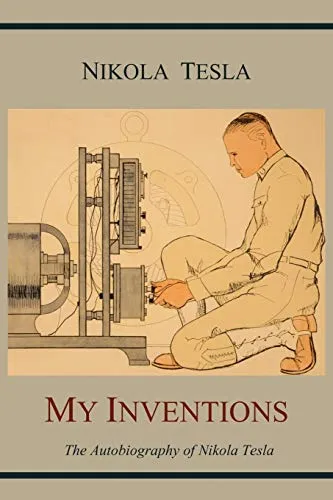
I didn’t get a recommendation for this one but Tesla is well-known and I love autobiographies, so I read it.
Maybe you know him as the crazy inventor who was obsessed with the number three (It’s true, it was in the book!) and think the book is just about electricity.
Tesla’s autobiography is introspective, and the rest is a lot about electricity. So when I finished the book I had two feelings. I know now a lot of personal memories of Tesla, and how he lived and what he liked to do. And some blurry ideas about electricity’s. I know about as much as chemistry in high school. I remember the half empty rectangle with small cells inside each that each had a letter.
The first chapter of the book are personal and about his memories growing up. It has so much details to the point that I wanted to also write more about how I feel about stuff. Reading this book really pushed me to write more.
His childhood is filled with stories that you kinda wanna hear from a boy who becomes an inventor. Inspiring parents that prepare mentally prepare him, a boy who is in love with manufacturing machines from all sorts of stuff he could find. The classic story of reading under lights of a candle.
He talks about his personal feelings. The ideas that made him sad and happy. Like when they moved from countryside into a town and he got pretty depressed because he missed the animals and the nature.
This book also gets pretty philosophical and electrical! His life is filled with stories. He moves to multiple cities in Europe. Works multiple jobs and then moves to the USA to work for Edison.
He has done a lot of work and is known for many inventions but after reading the book I figured out that he had even more ideas and wanted to do more. Some of his ideas never got any attention and funded. But they are actually very futuristic ideas.
He was talking about phones 120 years ago!
The world system has resulted from a combination of several original discoveries made by the inventor in the course of long continued research and experimentation. It makes possible not only the instantaneous and precise wireless transmission of any kind of signals, messages or characters, to all parts of the world, but also the inter-connection of the existing telegraph, telephone, and other signal stations without any change in their present equipment. By its means, for instance, a telephone subscriber here may call up and talk to any other subscriber on the Earth. An inexpensive receiver, not bigger than a watch, will enable him to listen anywhere, on land or sea, to a speech delivered or music played in some other place, however distant.
He’s talking about childhood memories and feelings because he believes in that era we shape our personality. As we get older we have routines and habits that make a change harder.
Our first endeavors are purely instinctive prompting of an imagination vivid and undisciplined. As we grow older reason asserts itself and we become more and more systematic and designing. But those early impulses, though not immediately productive, are of the greatest moment and may shape our very destinies. Indeed, I feel now that had I understood and cultivated instead of suppressing them, I would have added substantial value to my bequest to the world.
His father was a clergyman, more specifically a military school dropout that became a priest. And he wanted Nikola to also be a priest as well. The innovative instinct did not come from him, but it came from his mother.
He hid the candles when he found that I was reading in secret. He did not want me to spoil my eyes. But I obtained tallow, made the wicking and cast the sticks into tin forms, and every night I would bush the keyhole and the cracks and read.
On another occasion he was taking out for a drive, a friend who carelessly permitted his costly fur coat to rub on the carriage wheel. My father reminded him of it saying, “Pull in your coat; you are ruining my tire.” He had the odd habit of talking to himself and would often carry on an animated conversation and indulge in heated argument, changing the tone of his voice. A casual listener might have sworn that several people were in the room.
His mother was illiterate, but you don’t need to read or write to build stuff, do you?
She invented and constructed all kinds of tools and devices and wove the finest designs from thread which was spun by her. She even planted seeds, raised the plants and separated the fibbers herself. She worked indefatigably, from break of day till late at night, and most of the wearing apparel and furnishings of the home were the product of her hands.
One of his habits that is mentioned throughout the book is being able to imagine stuff with great details in his mind. He likes to imagine things and once the details are figured out in his head start building. I think pen and paper was quite common and that time, but he still preferred the imagination way. Which has it’s benefits. With imagination you can focus on some things and your mind removes the details. The details are important when actually building or designing but at the beginning it kinda slows you down to think of all the small details of a device. That’s what he did, focus on the important parts and figure them out then worry about the details.
This I did constantly until I was about seventeen, when my thoughts turned seriously to invention. Then I observed to my delight that i could visualize with the greatest facility. I needed no models, drawings or experiments. I could picture them all as real in my mind. Thus I have been led unconsciously to evolve what I consider a new method of materializing inventive concepts and ideas, which is radically opposite to the purely experimental and is in my opinion ever so much more expeditious and efficient.
But it didn’t start like this. This started to him as what he calls flashes. I haven’t seen anything like this so I don’t know if this is a medical condition or not. He would see images in his mind from past memories and objects with great detail. And the painful part was that it interfered with he’s sight.
I was about twelve years of age when I first succeeded in banishing an image from my vision by willful effort, but I never had any control over the flashes of light to which I have referred. They were, perhaps, my strangest and most inexplicable experience. They usually occurred when I found myself in a dangerous or distressing situations or when i was greatly exhilarated. In some instances i have seen all the air around me filled with tongues of living flame. Their intensity, instead of diminishing, increased with time and seemingly attained a maximum when I was about twenty-five years old.
While in Paris in 1883, a prominent French manufacturer sent me an invitation to a shooting expedition which I accepted. I had been long confined to the factory and the fresh air had a wonderfully invigorating effect on me. On my return to the city that night, I felt a positive sensation that my brain had caught fire. I was a light as though a small sun was located in it and I passed the whole night applying cold compressions to my tortured head. Finally the flashes diminished in frequency and force but it took more than three weeks before they wholly subsided. When a second invitation was extended to me, my answer was an emphatic NO!
I miss thinking through things before starting them out. I do type usually these days but I barely use pen and paper to write down. But also it’s probably easier these days to try something than to think through it compared to 100 years ago.
My method is different. I do not rush into actual work. When I get an idea, I start at once building it up in my imagination. I change the construction, make improvements and operate the device in my mind. It is absolutely immaterial to me whether I run my turbine in thought or test it in my shop. I even note if it is out of balance. There is no difference whatever; the results are the same. In this way I am able to rapidly develop and perfect a conception without touching anything. When I have gone so far as to embody in the invention every possible improvement I can think of and see no fault anywhere, I put into concrete form this final product of my brain. Invariably my device works as I conceived that it should, and the experiment comes out exactly as I planned it. In twenty years there has not been a single exception. Why should it be otherwise? Engineering, electrical and mechanical, is positive in results. There is scarcely a subject that cannot be examined beforehand, from the available theoretical and practical data. The carrying out into practice of a crude idea as is being generally done, is, I hold, nothing but a waste of energy, money, and time.
I like to think about this in programming. Usually, I think through something beforehand but mostly never write it down. When it’s hard I sometimes use pen and paper to play with ideas in my head. This helps because the idea sticks to my head and maybe few days later I get the idea and then come back to do it.
But with writing, I think it’s the exact opposite. No amount of contemplating in writing is useful, at least for me. I need to sit down and start writing whatever that comes to my mind for what I want to write. When I have something it’s much easier to iterate on it and I continue it. But thinking exactly what I want to write and then come back to write it? Never happened.
I think this has to do with how these activities are. With writing there is less structure to it and keeping it all in my mind is harder. I cannot keep sentences in my mind. But with programming I can think of the point I am right now and where do I want to go, and figure out the high level steps in between. This is the analogy I have for this.
Another attribute that he talks about is introspection.
In the course of time this vigorous mental exercise became second to nature. At the outset my wishes had to be subdued but gradually desire and will grew to be identical. After years of such discipline I gained so complete a mastery over myself that I toyed with passions which have meant destruction to some of the strongest men. At a certain age I contracted a mania for gambling which greatly worried my parents. To sit down to a game of cards was for me the quintessence of pleasure.
And after examining his habits he could remove the ones that were hurting him.
Long ago I suffered from heart trouble until I discovered that it was due to the innocent cup of coffee I consumed every morning. I discontinued at once, though I confess it was not an easy task. In this way I checked and bridled other habits and passions, and have not only preserved my life but derived an immense amount of satisfaction from what most men would consider privation and sacrifice.
But at some point he really fucks up with gambling. You know this is going to happen so his mother saves him. So kids don’t do drugs.
She understood the character of men and knew that one’s salvation could only be brought about through his own efforts. One afternoon, I remember, when I had lost all my money and was craving for a game, she came to me with a roll of bills and said, ‘Go and enjoy yourself. The sooner you lose all we possess, the better it will be. I know that you will get over it.’ She was right. I conquered my passion then and there and only regretted that it had not been a hundred times as strong.
I want to end this section on his childhood thoughts and thinking. With this passage:
The pressure of occupation and the incessant stream of impressions pouring into our consciousness through all the gateways of knowledge make modern existence hazardous in many ways. Most persons are so absorbed in the contemplation of the outside world that they are wholly oblivious to what is passing on within themselves. The premature death of millions is primarily traceable to this cause.
He was a playful kid. He created toys for himself and played in nature. The whole family moved to a bigger, Gospic, after his brother died in a horse riding accident. And this made him miss the countryside.
These are some of the fun memories:
Like most children, I was fond of jumping and developed an intense desire to support myself in the air. Occasionally a strong wind richly charged with oxygen blew from the mountains, rendering my body light as cork and then I would leap and float in space for a long time. It was a delightful sensation and my disappointment was keen when later I undeceived myself.
In my next attempt, I seem to have acted under the first instinctive impulse which later dominated me, to harness the energies of nature to the service of man. I did this through the medium of May bugs, or June bugs as they are called in America, which were a veritable pest in that country and sometimes broke the branches of trees by the sheer weight of their bodies. The bushes were black with them. I would attach as many as four of them to a crosspiece, rotably arranged on a thin spindle, and transmit the motion of the same to a large disc and so derive considerable ‘power.’ These creatures were remarkably efficient, for once they were started, they had no sense to stop and continued whirling for hours and hours and the hotter it was, the harder they worked. All went well until a strange boy came to the place. He was the son of a retired officer in the Austrian army. That urchin ate Maybugs alive and enjoyed them as though they were the finest blue-point oysters. That disgusting sight terminated my endeavors in this promising field and I have never since been able to touch a Maybug or any other insect for that matter.
Turning a wheel with Maybugs was something I had to search because it sounds very cool. He used bugs to make a wheel turn. I wanted to see if there’s any thing is available on how. But there is not. I imagine it was like gluing them at a specific angle to the wheel so when they tried to move they all turned the wheel a little.
Shortly thereafter, I went into the manufacture of a kind of popgun which comprised a hollow tube, a piston, and two plugs of hemp. When firing the gun, the piston was pressed against the stomach and the tube was pushed back quickly with both hands. The air between the plugs was compressed and raised to a high temperature and one of them was expelled with a loud report. The art consisted in selecting a tube of the proper taper from the hollow stalks which were found in our garden. I did very well with that gun, but my activities interfered with the window panes in our house and met with painful discouragement.
I made all kinds of other contrivances and contraptions but among those, the arbalests I produced were the best. My arrows, when short, disappeared from sight and at close range traversed a plank of pine one inch thick. Through the continuous tightening of the bows I developed a skin on my stomach much like that of a crocodile and I am often wondering whether it is due to this exercise that I am able even now to digest cobblestones!
If I remember rightly, I then took to carving swords from pieces of furniture which I could conveniently obtain. At that time I was under the sway of the Serbian national poetry and full of admiration for the feats of the heroes. I used to spend hours in mowing down my enemies in the form of cornstalks which ruined the crops and netted me several spankings from my mother. Moreover, these were not of the formal kind but the genuine article.
Among other things, I attained the unique distinction of champion crow catcher in the country. My method of procedure was extremely simple. I would go into the forest, hide in the bushes, and imitate the call of the birds. Usually I would get several answers and in a short while a crow would flutter down into the shrubbery near me. After that, all I needed to do was to throw a piece of cardboard to detract its attention, jump up and grab it before it could extricate itself from the undergrowth. In this way I would capture as many as I desired. But on one occasion something occurred which made me respect them. I had caught a fine pair of birds and was returning home with a friend. When we left the forest, thousands of crows had gathered making a frightful racket. In a few minutes they rose in pursuit and soon enveloped us. The fun lasted until all of a sudden I received a blow on the back of my head which knocked me down. Then they attacked me viciously. I was compelled to release the two birds and was glad to join my friend who had taken refuge in a cave.
I was practicing while walking with my uncle along the river. The sun was setting, the trout were playful and from time to time one would shoot up into the air, its glistening body sharply defined against a projecting rock beyond. Of course any boy might have hit a fish under these propitious conditions but I undertook a much more difficult task and I foretold to my uncle, to the minutest detail, what I intended doing. I was to hurl a stone to meet the fish, press its body against the rock, and cut it in two. It was no sooner said than done. My uncle looked at me almost scared out of his wits and exclaimed “Vade retra Satanae!” and it was a few days before he spoke to me again.
Mechanical flight was the one thing I wanted to accomplish although still under the discouraging recollection of a bad fall I sustained by jumping with an umbrella from the top of a building. Every day I used to transport myself through the air to distant regions but could not understand just how I managed to do it.
The sight of a pearl would almost give me a fit, but I was fascinated with the glitter of crystals or objects with sharp edges and plane surfaces. I would not touch the hair of other people except, perhaps at the point of a revolver.
While showing all these signs his father still wanted to send him to clergy. He had to deal with two hard diseases.
First he had Malaria. And during his recovery he read a lot of Mark Twain books.
One day I was handed a few volumes of new literature unlike anything I had ever read before and so captivating as to make me utterly forget me hopeless state. They were the earlier works of Mark Twain and to them might have been due the miraculous recovery which followed. Twenty-five years later, when I met Mr. Clemens and we formed a friendship between us, I told him of the experience and was amazed to see that great man of laughter burst into tears.
Second time he was in a more serious condition Where physicians gave up on him. At this time his father changed his mind and told Tesla that he will send him to the best engineering school. That’s what gave him the energy to get up again.
He was pretty good during that time. To the point that his teachers were worried about him.
Armed with their flattering certificate, I went home for a short rest, expecting triumph, and was mortified when my father made light of these hard-won honors. That almost killed my ambition; but later, after he had died, I was pained to find a package of letters which the professors had written to him to the effect that unless he took me away from the Institution I would be killed through overwork.
The idea for one of the inventions of Tesla came from this memory in Graz university.
While Professor Poeschl was making demonstrations, running the machine was a motor, the brushes gave trouble, sparking badly, and I observed that it might be possible to operate a motor without these appliances. But he declared that it could not be done and did me the honor of delivering a lecture on the subject, at the conclusion he remarked, Mr. Tesla may accomplish great things, but he certainly will never do this. It would be equivalent to converting a steadily pulling force, like that of gravity into a rotary effort. It is a perpetual motion scheme, an impossible idea. But instinct is something which transcends knowledge. We have, undoubtedly, certain finer fibbers that enable us to perceive truths when logical deduction, or any other willful effort of the brain, is futile.
I had to lookup what are brushes and what they do in a motor. This video is useful to have some idea. The brush name is confusing to me because I thought it’s a literal brush but it’s the point that wires are in contact with electricity when the motor spins. Watch the video definitely.
After his study he works in Europe at the Telegraph office. And the idea from rotating magnetic field comes to his mind somewhere in a park.
The consummation of the experiment was, however, delayed until the summer of that year, when I finally had the satisfaction of seeing the rotation effected by alternating currents of different phase, and without sliding contacts or commutator, as I had conceived a year before. It was an exquisite pleasure but not to compare with the delirium of joy following the first revelation.
For a while I gave myself up entirely to the intense enjoyment of picturing machines and devising new forms. It was a mental state of happiness about as complete as I have ever known in life. Ideas came in an uninterrupted stream and the only difficulty I had was to hold them fast. The pieces of apparatus I conceived were to me absolutely real and tangible in every detail, even to the minutest marks and signs of wear. I delighted in imagining the motors constantly running, for in this way they presented to the mind’s eye a fascinating sight.
After Budapest he moves to Paris and works Edison’s European company. The famous Edison. During this time he moves around to Austria and Germany to fix stuff. He knew a lot of languages and that was an advantage to be able to move this easily!
One of his funny stories from Germany, that you can still say as a joke about them, is this one:
An incandescent lamp of 16 c.p. was to be placed in a hallway, and upon selecting the proper location, I ordered the “monteur” to run the wires. After working for a while, he concluded that the engineer had to be consulted and this was done. The latter made several objections but ultimately agreed that the lamp should be placed two inches from the spot I had assigned, whereupon the work proceeded. Then the engineer became worried and told me that Inspector Averdeck should be notified. That important person was called, he investigated, debated, and decided that the lamp should be shifted back two inches, which was the place I had marked! It was not long, however, before Averdeck got cold feet himself and advised me that he had informed Ober-Inspector Hieronimus of the matter and that I should await his decision. It was several days before the ober-inspector was able to free himself of other pressing duties, but at last he arrived and a two hour debate followed, when he decided to move the lamp two inches further. My hopes that this was the final act, were shattered when the ober-inspector returned and said to me, “Regierungsrath Funke is particular that I would not dare to give an order for placing this lamp without his explicit approval.” Accordingly, arrangements for a visit from that great man were made. We started cleaning up and polishing early in the morning, and when Funke came with his retinue he was ceremoniously received. After two hours of deliberation, he suddenly exclaimed, “I must be going!,” and pointing to a place on the ceiling, he ordered me to put the lamp there. It was the exact spot which I had originally chosen!
Or as he puts it in a succinct way:
There were three administrators, whom I shall designate as A, B, and C for convenience. When I called on A, he told me what B had the say. This gentleman thought that only C could decide, and the latter was quite sure that A alone had the power to act. After several laps of this circulus viciousus, it dawned upon me that my reward was a castle in Spain.
At some point they realize his pretty good and send him to the US.
Where he meets with Edison. The famous Edison.
One evening, in the winter of 1885, Mr. Edison, Edward H. Johnson, the President of the Edison Illuminating Company, Mr. Bachelor, Manager of the works, and myself, entered a little place opposite 65 Firth Avenue, where the offices of the company were located. Someone suggested guessing weights and I was induced to step on a scale. Edison felt me all over and said: “Tesla weighs 152 lbs. to an ounce,” and he guessed it exactly. Stripped I weighed 142 pounds, and that is still my weight. I whispered to Mr. Johnson; “How is it possible that Edison could guess my weight so closely?” “Well,” he said, lowering his voice. “I will tell you confidentially, but you must not say anything. He was employed for a long time in a Chicago slaughter-house where he weighed thousands of hogs every day. That’s why.”
Tesla was really hard working. From reading this I get the impression that he was either sleeping or working on his ideas. Even his sleep was kinda like working with all that imagination and images.
But he also describes some cases where he realized that resting is needed.
So long as it operates I am safe from danger, due to overwork, which threatens other inventors, and incidentally, I need no vacations which are indispensable to most people. When I am all but used up, I simply do as the darkies who “naturally fall asleep while white folks worry.”
His analogy is funny, he says there’s some toxic agent that is produced in the body after long hours of working and only sleep can remove it.
To venture a theory out of my sphere, the body probably accumulates little by little a definite quantity of some toxic agent and I sink into a nearly lethargic state which lasts half an hour to the minute. Upon awakening I have the sensation as though the events immediately preceding had occurred very long ago, and if I attempt to continue the interrupted train of thought I feel veritable nausea. Involuntarily, I then turn to other and am surprised at the freshness of the mind and ease with which I overcome obstacles that had baffled me before. After weeks or months, my passion for the temporarily abandoned invention returns and I invariably find answers to all the vexing questions, with scarcely any effort.
But what was he working on at this time? The idea that I mentioned at the beginning, the wireless system.
This system as he puts it was a way to transfer electricity and with that information wirelessly. And the most fascinating part is using earth and atmosphere to do this. Again, I don’t know anything about physics pas the basic formulas I memorized in high school.
But he says that he did experiments to showcase his idea, at least it was proven working in a small scale.
In demonstrating my invention before audiences, the visitors were requested to ask questions, however involved, and the automaton would answer them by signs. This was considered magic at the time, but was extremely simple, for it was myself who gave the replies by means of the device. At the same period, another larger telautomatic boat was constructed, a photograph of which was shown in the October 1919 number of the Electrical Experimenter.
His reasoning on why he thought controlling machines can be done or is a good thing to explore came from his realization form his body. That he’s body is an automation that reacts to the forces from external world. So the machines can be like that too.
The practical result of this was the art of tele automatics which has been so far carried out only in an imperfect manner. Its latent possibilities will, however be eventually shown. I have been years planning self-controlled automata and believe that mechanisms can be produced which will act as if possessed of reason, to a limited degree, and will create a revolution in many commercial and industrial departments.
After a while this effort grew to be almost automatic and I gained great facility in connecting cause and effect. Soon I became aware, to my surprise, that every thought I conceived was suggested by an external impression. Not only this but all my actions were prompted in a similar way. In the course of time it became perfectly evident to me that I was merely an automation endowed with power of movement responding to the stimuli of the sense organs and thinking and acting accordingly.
I found this explanation of the ionized air very funny which I think came from all this wireless experiments:
Most generally, I employed receiving circuits in the form of loops, including condensers, because the discharges of my high-tension transmitter ionized the air in the (laboratory) so that even a very small aerial would draw electricity from the surrounding atmosphere for hours. Just to give an idea, I found, for instance, that a bulb twelve inches in diameter, highly exhausted, and with one single terminal to which a short wire was attached, would deliver well on to one thousand successive flashes before all charge of the air in the laboratory was neutralized.
I don’t know what happened that people didn’t take him seriously. Because I don’t see any mention of this wireless system anywhere. Did they think that he was doing some tricks and it’s not real or it never really worked?
But anyway the idea that he could do something like this remotely made him think about the future a lot and they turned out to be true. Just thinking about the effect of technology in general.
It is particularly regrettable that a punitive policy was adopted in framing the terms of peace, because a few years hence, it will be possible for nations to fight without armies, ships or guns, by weapons far more terrible, to the destructive action and range of which there is virtually no limit. Any city, at a distance, whatsoever, from the enemy, can be destroyed by him and no power on earth can stop him from doing so. If we want to avert an impending calamity and a state of things which may transform the globe into an inferno, we should push the development of flying machines and wireless transmission of energy without an instant’s delay and with all the power and resources of the nation.
And this is a good quote on what technical improvements are good:
The greatest good will come from technical improvements tending to unification and harmony, and my wireless transmitter is preeminently such. By its means, the human voice and likeness will be reproduced everywhere and factories driven thousands of miles from waterfalls furnishing power. Aerial machines will be propelled around the earth without a stop and the sun’s energy controlled to create lakes and rivers for motive purposes and transformation of arid deserts into fertile land.
His looking at the aspect of what technologies and eliminate wars. Not to avoid them with power but to make nations more connected together, so different people can see each other and realize that other people living thousands of kilometers away are still people. While we don’t have an answer yet I think this is a good one I think this a good addition to tech judge.
After many such cases I confided this to a number of friends, who had the opportunity to convince themselves of the theory of which I have gradually formulated and which may be stated in the following few words: Our bodies are of similar construction and exposed to the same external forces. This results in likeness of response and concordance of the general activities on which all our social and other rules and laws are based. We are automata entirely controlled by the forces of the medium, being tossed about like corks on the surface of the water, but mistaking the resultant of the impulses from the outside for the free will. The movements and other actions we perform are always life preservative and though seemingly quite independent from one another, we are connected by invisible links. So long as the organism is in perfect order, it responds accurately to the agents that prompt it, but the moment that there is some derangement in any individual, his self-preservative power is impaired.