Book Review: No Ordinary Genius
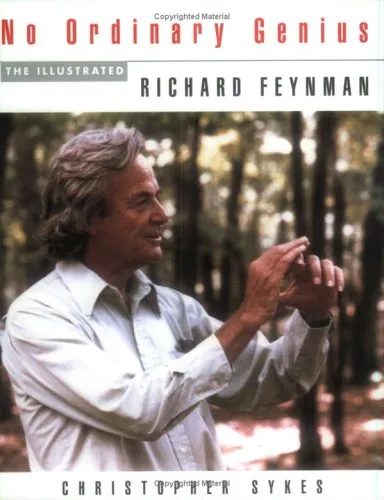
This is the third book I read about Feynman. At this point I’m seeing repeating stories so I probably stop reading biographies of him. I have other books from him that I want to read in the future.
Feynman is an unusual person. When you read about his life you notice the difference. He cares about different things than a usual person. You usually find people who like Money, or Fame, or Power. He had these but it’s not part of his personality.
This book records opinions of others about him. Including family, friends, and coworkers. And the repeating theme is unusual things that Feynman did. The kind of stuff that challenges my assumption of a scientist.
It reminds of the question “How do you recognize a false prophet?”. And the answer is, it does everything you expect a prophet to do. Feynman is definitely not what I expected a scientist would live like.
This story is funny how someone who won the noble prize didn’t wrote stuff for publishing.
Feynman didn’t publish what he did; I published it. That’s my nature-I enjoy publishing things. He hated writing. There’s a famous story about how he actually did finally publish some stuff, and it came about because he went to stay with an old friend called Muleika Corben. She was another of his intellectual friends-I mean, as far as I know, there was no romance between them. But Muleika was an extremely bright young woman, the wife of a physicist in Pittsburgh. She was forceful as well as being bright. She got Feynman into her house, and simply locked him up in a room and refused to let him out until he’d written the paper. I think she even refused to feed him unless he wrote it. So there was nothing for it-he had to sit down and write, and that’s how it happened. It did take extreme measures to persuade him to write anything!
He explained stuff to people and solved their problems for them but didn’t write stuff for publishers.
When you think about unusual stuff. Things that sound insane you sometimes see the future actually. This is Feynman thinking about machine learning circa 1960:
I remember a crazy thing he was trying to work on. He had a little box that he wanted to talk to by sending in symbols, and getting it to repeat things. So he would say “Blue” and show it a blue thing. Then next time he showed it a blue thing. he wanted it to say “Blue. " I guess his idea would be that it was kind of like a baby and he would teach it, which I think is a great idea-that’s in some sense what I work on. But his idea of how it ought to work inside was pretty naive. He kind of stuck with it for a while-who knows what would have happened if he had stuck with it for a few years more?
The new thing I read that was not in his other books, Surely You’re Joking, Mr. Feynman!, and What Do You Care What Other People Think? was his interest in making things very small or very big.
Why cannot we write the entire twenty-four volumes of the Encyclopaedia Britannica on the head of a pin? Let’s see what would be involved. The head of a pin is a sixteenth of an inch across. If you magnify it by twentyfive thousand diameters, the area of the head of the pin is then equal to the area of all the pages of the Encyclopaedia Britannica. Therefore, all that is necessary is to reduce in size all the writing in the encyclopedia by twenty-five thousand times. Is that possible? The resolving power of the eye is about 1 /1 2oth of an inch-that is roughly the diameter of one of the little dots on the fine halftone reproductions in the encyclopedia. This, when you demagnify it by twenty-five thousand times, is still eighty angstroms in diameter-thirty-two atoms across, in an ordinary metal. In other words, one of those dots still would contain in its area one thousand atoms. So, each dot can easi ly be adjusted in size as required by the photoengraving, and there is no question that there is enough room on the head of a pin to put all of the Encyclopaedia BritannicBut first, before I start on machines, I’d like to talk about very small writing. How small can we make writing. or numbers? What’s the smallest you can possibly make them? I don’t mean if you’re very delicate with your fingers how small you can make them; I mean with special machinery, and so on-what is the ultimate limit?Why cannot we write the entire twenty-four volumes of the Encyclopaedia Britannica on the head of a pin? Let’s see what would be involved. The head of a pin is a sixteenth of an inch across. If you magnify it by twentyfive thousand diameters, the area of the head of the pin is then equal to the area of all the pages of the Encyclopaedia Britannica. Therefore, all that is necessary is to reduce in size all the writing in the encyclopedia by twenty-five thousand times. Is that possible? The resolving power of the eye is about 1 /1 2oth of an inch-that is roughly the diameter of one of the little dots on the fine halftone reproductions in the encyclopedia. This, when you demagnify it by twenty-five thousand times, is still eighty angstroms in diameter-thirty-two atoms across, in an ordinary metal. In other words, one of those dots still would contain in its area one thousand atoms. So, each dot can easi ly be adjusted in size as required by the photoengraving, and there is no question that there is enough room on the head of a pin to put all of the Encyclopaedia Britannica.
This is pretty much like computers right? We take information compress it into tiny parts and then read it back. All of is just thinking about how to make something small. Compression is a fun idea to think about.
He later also puts a prize for the person who can make a small motor:
And I want to offer another prize-if I can figure out how to phrase it so that I don’t get into a mess of arguments about definitions-of another one thousand dollars to the first guy who makes an operating electric motor-a rotating electric motor-which can be controlled from the outside and, not counting the lead-in wires, is only a onesixty-fourth-inch cube. I do not expect that such prizes will have to wait long for claimants. The tiny-motor prize was claimed within a year by a Pasadena electrical engineer named William MacLellan .
His travels are also unusual. He went to places where you don’t know anything about. This travel story is about going to Kyzyl. I don’t expect you to know where is it.
Now there are people who would be afraid to go to such places; they’re not sure the accommodations will be good enough, they’re not sure of this, they’re not sure of that, they wouldn’t do it. Well, they’re missing the delight of surprise. So yes, the moral is: be brave, forget it, nothing bad will happen! If you get rained on, someone will pick you up. I can’t explain it, but it always works well. Sometimes we go on a trip across the country slowly, camping out at night, and to find a site we turn off the highway, and at every turn we take the worst road! We do that in the daytime, too, just to explore. Anyway, Ralph was delighted with this crazy idea. That’s how it started.
Why is it a hard travel plan? Nobody spoke Tuvan language. They had to communicate to embassy to get visa to go there. This is how it went:
We found somehow this Mongolian-Tuvan-Russian Feynman phrasebook, which was just wonderful . Now that we had the phrasebook we would write in Tuvan; that would probably wake somebody up, you see. So we struggled, and this is the kind of thing I love-try to put something together, taking all the phrases and trying to make the minimum changes on any of the phrases so that we would be able to put together the phrases in order to say to some- one, “Greetings to your country from ours! We have a great interest in Tuva, and we hope someday to come to visit and we would look forward to see you, and if there’s any way that you can send us tapes of your language we would appreciate it. . . . All good wishes,” all this kind of stuff. It sounds a little odd that you could make all that out of a phrasebook, but actually it was rather a good one, and it had a lot of stuff in it-“phono-recordings,” and things like that. So we wrote this letter into the vacuum as usual, and nothing happened. Then one day Ralph comes running over here waving a letter in the air! He was so excited he didn’t open it yet. A letter had come from Tuva. With the stamps-well. Russian stamps, but it had come from Kyzyl. So we opened it. And then of course we couldn’t read it because it was in Tuvan! We worked very patiently back and forth, because we had to go through the phrasebook into Russian, and then from Russian into English. His name was Ondar Daryma. “Greetings from Tuva! Kyzyl is a nice city! You will find we have a statue of the center of Asia . . . . "
Travel is so much fun this way. Isn’t it?